Spring 2023 – Status Report
Prepared By: Dave Adams (Manager of the Kichi Sibi Winter Trail) in cooperation with the Westboro Beach Community Association
Date: Spring 2023
Background:
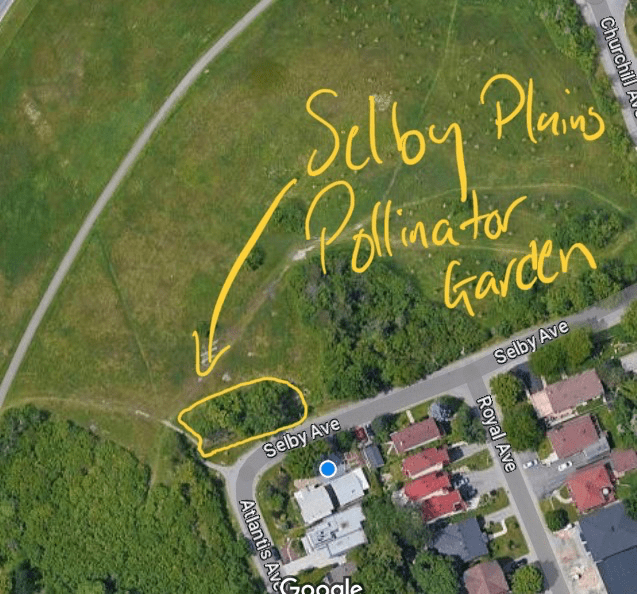
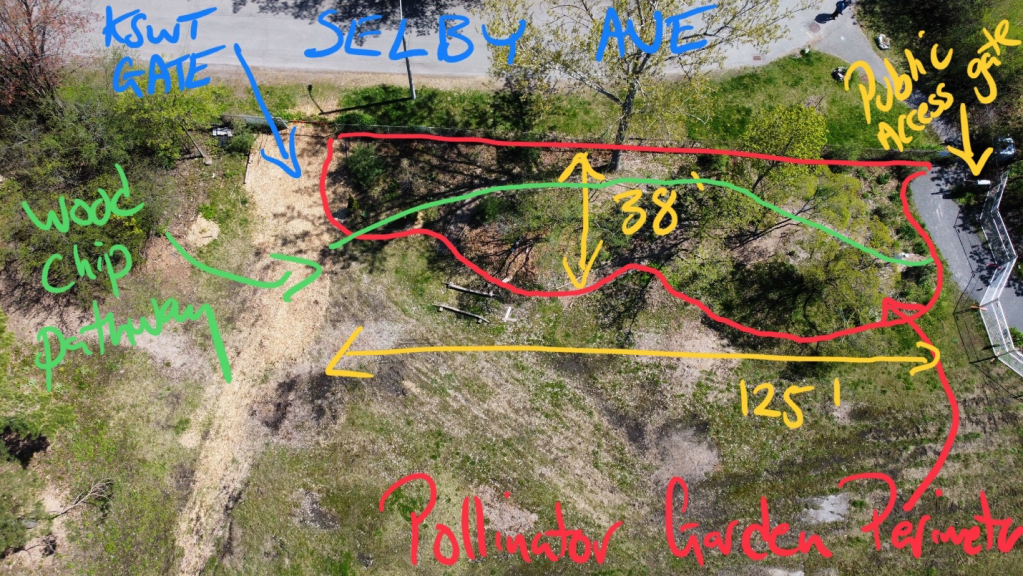
With the creation of an equipment service gate to support the Kichi Sibi Winter Trail, a small section of land adjacent to Selby Avenue was cleared two years ago of European Buckthorn, an invasive plant. With its removal, an opportunity arose, and this was to use the freshly cleared area to re-introduction native pollinator plants and native tree species. Seed stock and transplants were provided by the Fletcher Gardens and neighbours but with the condition that all donations had to be native plants/trees and effective pollinators.
The pollinator garden is 4750 Sq Feet or .1 of an acre in size. With it being small, the space is a manageable size by local residents, many of whom are skilled and experienced in these activities.
Keeping past studies in mind like the “Westboro Beach Area Stewardship Project”, which highlights that pollinator gardens are important and desirable for the Westboro Beach area, it is hoped that this garden will be the first of many that will help the biological and ecological diversity of our area.
The Westboro Beach Community Association endorses the project. The NCC did a site inspection by biologist Camille Tremblay.
Inventory:
| Native Plant Species | Quantity | Degree of Health | Introduced |
| Black Eyed Susan | sparse | yes | |
| Black Raspberry | sparse | no | |
| Blue Stem Golden Rod | yes | ||
| Butterfly Bush | |||
| Canada Columbine | sparse | excellent | yes |
| Canada Golden Rod | sparse | excellent | yes |
| Canadian Thistle | abundant | excellent | no |
| Catnip | abundant | no | |
| Common Mullein | abundant | no | |
| Common Yarrow | yes | ||
| Flowering Raspberry | |||
| Hedge Bedstraw | |||
| Joe Pye Weed | yes | ||
| Large Leaved Aster | yes | ||
| Lindheimer’s beeblossom | |||
| New England Aster | excellent | yes | |
| Orchard Grass | |||
| Prairie Smoke | |||
| Rough Golden Rod | no | ||
| Silverweed | Multiple | excellent | yes |
| Swamp Milkweed | yes | ||
| Trillium | sparse | no | |
| Yellow Rocket |
| Tree Species | Quantity | Approx. Age |
| White Pines | Sapling | |
| Cedars | 2 | sapling |
| Popular | 1 | mature |
| Amber Maple | mature | |
| Burr Oak | 1 | sapling |
| Norway Maple | juvenile | |
| White Spruce | 4 | sapling |
| Sumac | 1 | sapling |
| Boxelder Maple | 3 stands | Mature |
| Invasive Species Plant | Quantity |
| Dame’s Rocket | sparse |
| European Buch Thorn | sparse |
| Honey Suckle | sparse |
| Gout Weed | abundant |
Invasive Species Management:
Primarily it is the buckthorn that is the most abundant. Based on the recommendation of the “Westboro Beach Stewardship Program”, one approaches listed is the “Mowing Regime”. Essentially with regular monitoring and cutting down, over time these plants will be starved of light and will eventually die off.
This approach is the most achievable for our volunteers since this a project with no budget and limited tools.
The good news is that this approach seems to be working and buckthorn shoots are becoming less and less of a problem. We are observing that the native species transplants are starting to take hold and out compete the buckthorn that used to be so dominate.
There is one stand of Manitoba Maple still standing in the pollinator garden. The decision was made to leave it standing due to its ability to create shade.
Water Management:
In theory, all plants in the pollinator garden are native and have been selected for their characteristics of not needing a lot of water. Nevertheless, we want to set them up for success.
As a result, a water reservoir has been set up and plants get watered occasionally during dry spells by volunteers.
All small saplings also get extra attention during these vulnerable years in their development. They also have a berm of wood chips around their perimeter to minimize evaporation.
As the garden matures, it is hoped that less and less water subsidies will be required.
Community Engagement:
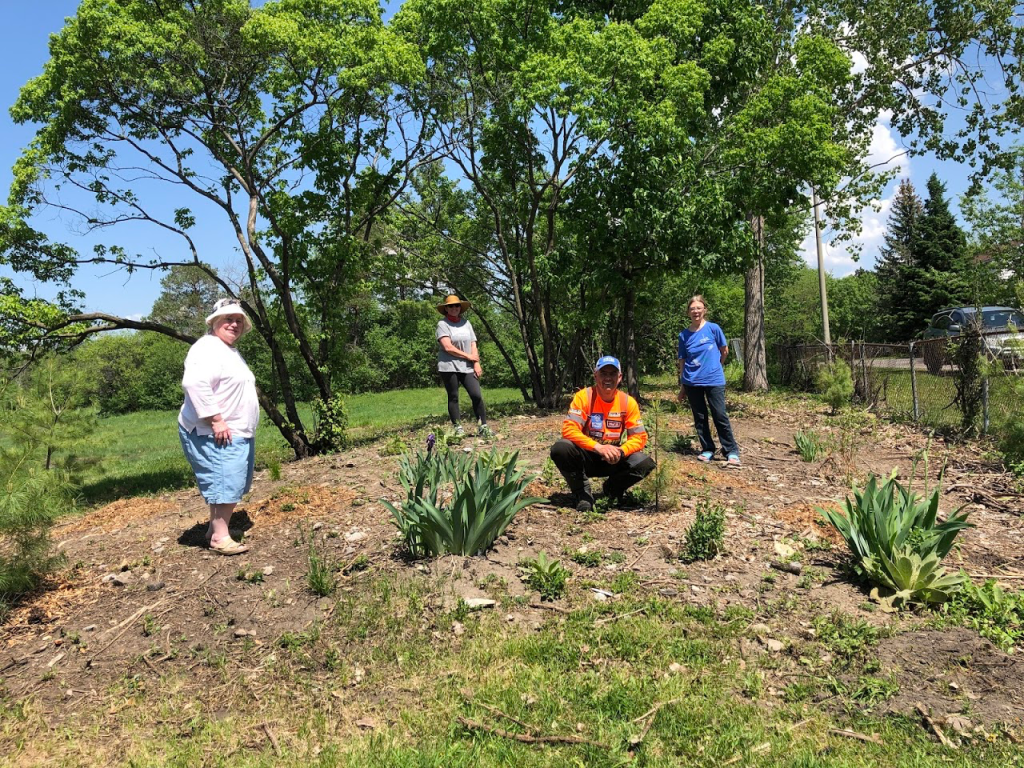
This project is endorsed by the Westboro Beach Community Association and coordinated by Groomer Dave of the Kichi Sibi Winter Trail. The garden is considered a joint project because it is mutually beneficial to the community association as well as the winter trail.
Neighbourhood children are also encouraged to help out by weeding and planting Common Milkweed seedlings that are propagated using seeds from Selby Plains.
And it should also be noted that an unforeseen, yet welcome, surprise is that this project has attracted outside interests. For example, local high school students have shown interest in the garden and are receiving high school credit for helping. Retired people have been another demographic that has come to help.
These two examples demonstrate the principle of “you build it, they will come” phenomena.
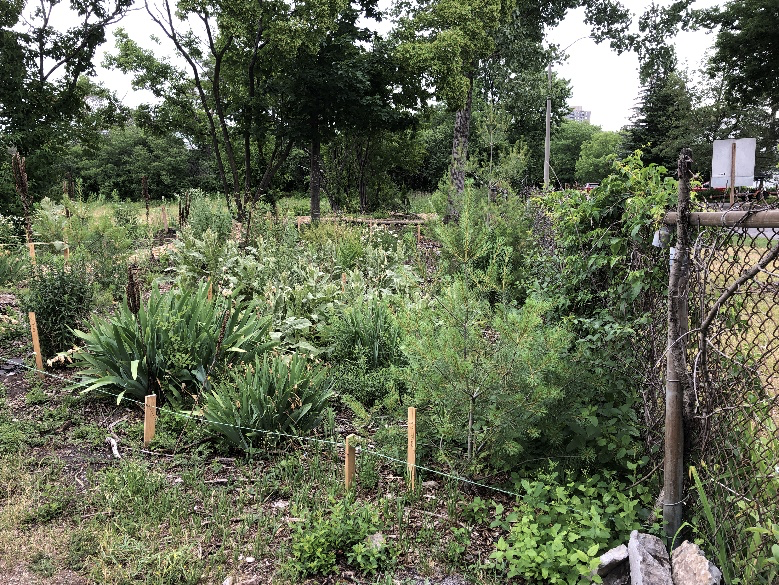
Picture from last summer (2022):
Detailed Map of Pollinator Garden:
Canada 150 Tree Project (Update):
Although the Canada 150 trees at the corner of Churchill North and Selby Avenue are outside the scope of this report, they are nevertheless in the vicinity and are part of the Selby Plains as a whole and hence, worthy of mention.
Unfortunately, the survival rate has been poor from the initial planting. Approximately, only 50 trees have survived. Possible causes of death have been the lack of soil and dry conditions. Both Selby Pollinator Garden and Royal Grove reside on large soil berms created during the cleanup after the creation of the SJAM Parkway.
Possible Next Steps:
- Accommodate Growing Trees. Like all gardens, things are always changing. But for the Selby Pollinator Garden, the trees that have been planted and are doing extremely well and as they grow, will start to take up more space. This will likely force some accommodate of the plants in their immediate vicinity and it may even mean they will have to be cut back. This could mean that the pollinator garden becomes less of a garden and more of a healthy forest. This is not such a bad thing.
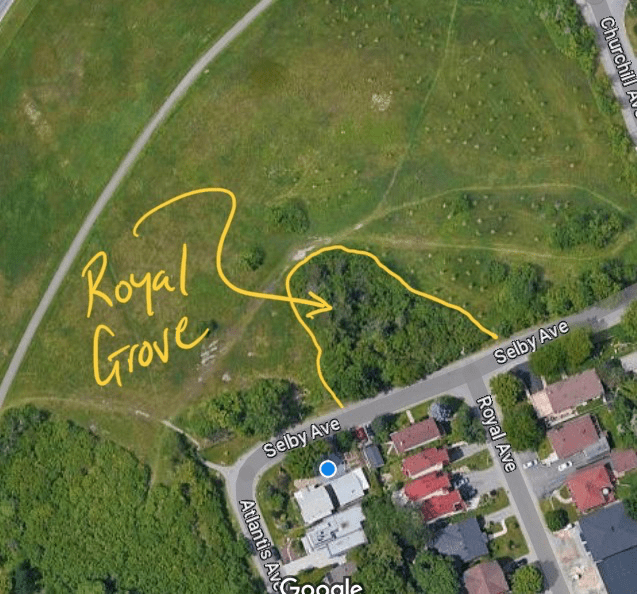
- Royal Grove. As the plants in the Selby Pollinator garden establish, mature and require less attention, we can considered continuing working east bound into another small area called Royal Grove. Once again, this is a piece of land ladened with European Buckthorn and similar to Selby Pollinator garden it too resides on a berm of soil left over from the days when they pushed soil off the plains and on to these berms adjacent to the roads. These soil deposits give it a competitive advantage of the lands to where the Canada 150 trees were planted.
Below is a map of the area:
Reference Links and ‘In the News”:
https://www.cbc.ca/news/canada/ottawa/westboro-beach-dead-maple-grove-trees-1.6093134
 Westboro Beach Community Association